 English
 Español
 简体中文
简体中文 العربية
 Deutsch
 Français
 Italiano
 Tiếng Việt
Protecting your home from wildfire
Steps to Protect Your Home From Wildfire
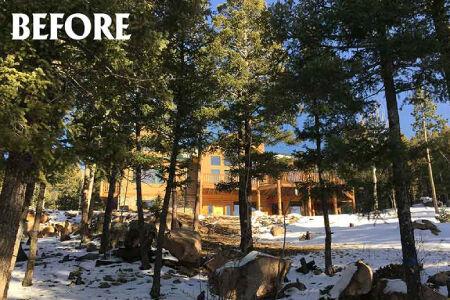
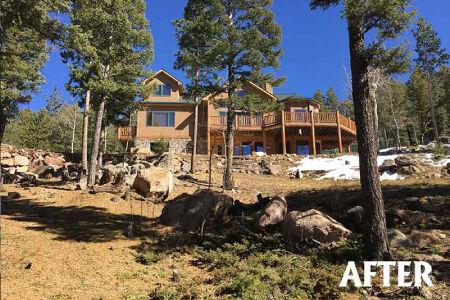
Do you live in or near a natural area of forest or grassland? This is the wildland urban interface or WUI, where fire is a natural occurrence and cannot always be stopped. You can be proactive by reducing fuels that could carry a wildfire to your home.
Wildfire defense starts with understanding embers. These small pieces of burning vegetation can be carried by winds over a mile ahead of a fire’s front. Embers can lodge in pine needles or leaf litter on a home’s roofs and gutters, or on flammable vegetation near the walls of your home.
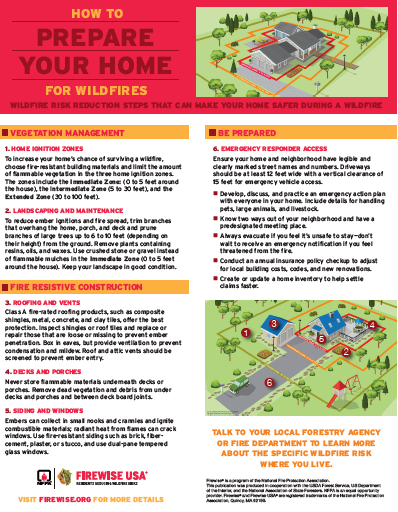
1. Check your home itself:
-
- Clear your roof and gutters of any pine needles or leaf accumulation.
- Check that your vents and soffits have screens 1/8 inch or smaller.
- Is your roof Class-A rated? If not, consider retrofitting to this standard.
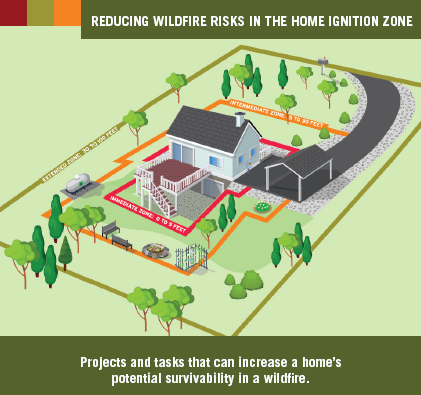
2. Clear out the first 5 feet from the walls of your home:
-
- Clear all dead vegetation, including plants, grass, weeds and pine needles. Maintain spacing between plants and trees.
- Move flammable items at least 5 feet away from your home, including wood piles, trash cans, deck chair cushions, and anything stored under your deck. Maintain space between those items.
- Replace combustible mulch with gravel or non-combustible material.
- Prune back large shrubs and trim overhanging branches.
3. Check the 5-30 foot zone
-
- Create breaks in vegetation. Mature tree canopy should be at least 10 feet from your home.
- Clear vegetation from around propane tanks, wood piles and outbuildings.
- Keep grasses mowed to 4 inches.
- Remove low-hanging tree branches up to 10 feet.
4. Check the 30-100 foot zone
-
- Clear out large piles of debris and leaf litter and remove dead trees.
- Create space between trees/clumps of trees: 6 feet within 60 feet and 12 feet within 100 feet of your home.
More steps towards Defensible Space
- Check with local nurseries to learn about fire resistant landscaping.
- Call your local Forestry office for more information.
- Fire Wise Plant Materials (for wildland urban interface areas)
- Grass Seed Mixes to Reduce Wildfire Hazard
- Defensible Space Guidelines
- NM Fire Resistant Plants
- Ember Awareness
Firewise
More information can be found at Firewise USA ®, a resource of many proportions. How to make defensible space around your home. Rate your home chances of surviving a wildland fire. Interactive items, publications, other links. Brought to you by the National Wildland/Urban Interface Fire Protection Program.
Wildfire Prepared Homes – IBHS
More information can be found at Firewise USA ®, a resource of many proportions. How to make defensible space around your home. Rate your home chances of surviving a wildland fire. Interactive items, publications, other links. Brought to you by the National Wildland/Urban Interface Fire Protection Program.
Getting homes ready to withstand a wildfire now has the addition of the Wildfire Prepared Homes program, started by the Insurance Institute for Business & Home Safety (IBHS). New Mexico is now the newest state in the west to offer certification opportunities to homeowners that could help keep home insurance.
Applications are available through wildfireprepared.org.
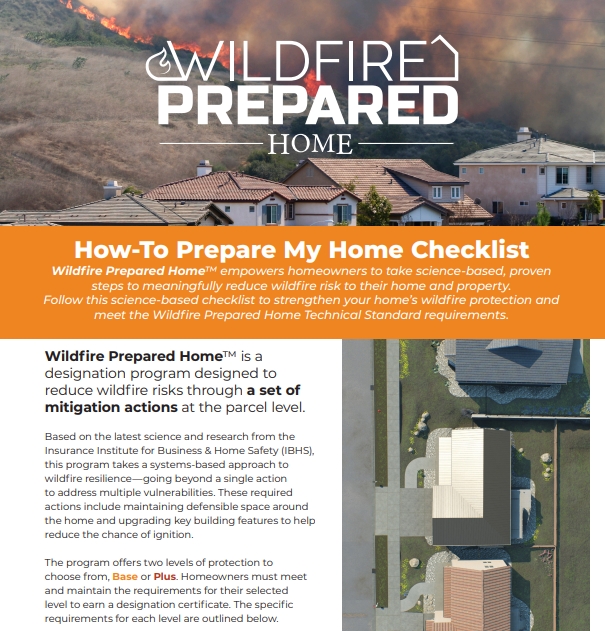
There, homeowners will find a checklist of the recommended standards homes are expected to meet for wildfire preparedness. After the home passes an assessment, a designation certificate is provided that can be sent to the property insurer a s proof of the Wildfire Prepared designation.
New Mexico residents receiving insurance through the F.A.I.R Plan can take advantage of grant opportunities for retrofit costs that may be incurred through the program by visiting the New Mexico Office of the Superintendent of Insurance’s website.
If a Wildfire is Burning Near Your Home
- Stay calm. Call 911 to report a fire.
- Cover all eave and roof vents.
- Cover large picture windows with plywood.
- Close all windows and doors; open drapes.
- Evacuate to a safe location