 English
 Español
 简体中文
简体中文 العربية
 Deutsch
 Français
 Italiano
 Tiếng Việt
Post Wildfire Coordination
Post Wildfire Coordination
South Fork Fire – Watershed Stabilization Program
Incident Summary
The South Fork and Salt Fires, sparked by lightning on June 17, 2025, burned 17,066 and 7,688 acres across the Lincoln National Forest Smokey Bear Ranger District, the Mescalero Apache Reservation, and the Village of Ruidoso. The fires were 99% contained by July 15, 2024. About 1,400 structures were destroyed, with more than 150 additional losses caused by post‑fire flooding.
Access archived press releases here, and view the South Fork Fire burned area here.
The Presenting Issue
Wildfires alter soil and vegetation, increasing the risk of flooding and landslides. Burned areas reduce the land’s ability to absorb rainfall—fire‑hardened soil sheds water quickly, accelerating runoff and raising the likelihood of flash flooding and debris flows. These heightened risks remain until vegetation naturally recovers.
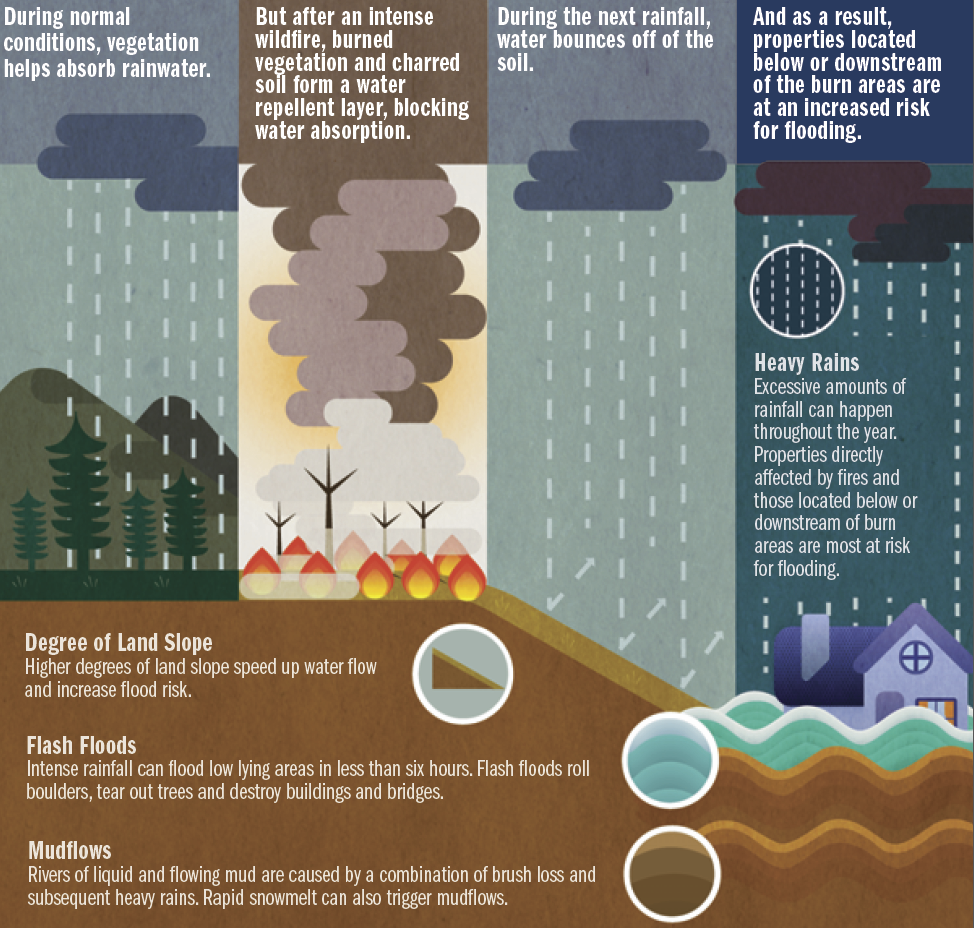
Image description: An illustration depicting wildfire effect on flooding downslope. Image credit: Federal Emergency Management Agency, U.S. Army Corps of Engineers.
South Fork Fire Watershed Stabilization Program Overview
The New Mexico Energy, Minerals and Natural Resources Department – Forestry Division is accepting requests from landowners affected by the Salt and South Fork Fires for post‑fire erosion control and hazardous tree mitigation. Contractors will assess each site and carry out approved work. The Forestry Division will have sole discretion to determine which post-fire practices are appropriate for each property.
Eligibility
Landowners requesting assistance will be evaluated for eligibility based on the following criteria:
Location
The property must be located in Lincoln County and within the boundaries of the South Fork burned area.
Proof of Ownership and Right of Entry
Applicants will complete a Right-of-Entry Agreement and provide legal proof of ownership which meets the document validation guidelines. Applications will not be accepted and approved for site assessment and project implementation until all documents are received and verified for legal acceptability.
It is the sole responsibility of the landowner or their representative to provide evidence of property ownership. Acceptable documents must list the current landowner and include the property address, legal description, and/or UPC.
Hazard Tree Criteria
Trees must be within twice their height of a road or structure and meet at least one of the following:
- Leaning more than 30 degrees
- Over 75% canopy loss (ponderosa pines) or over 50% loss (other species)
- Split trunk exposing heartwood
- 40% or more exposed roots
Priority Areas
Properties will be prioritized for assistance to maximize long-term watershed recovery, focusing on areas with the greatest risk of erosion that may contribute to debris flows and impact downstream communities. Prioritization will be based on:
- Proximity to other participating landowners
- Location within the watershed, with higher-elevation areas prioritized
- Burn severity, with higher-severity areas prioritized
- Terrain, with steeper slopes prioritized
The following map outlines priority treatment areas. Lighter areas represent high-priority treatment areas, darker areas represent lower-priority areas. Landowners who fall outside of these treatment areas should expect significant delays before the Division will be able to treat their properties.
This map will be updated quarterly to reflect progress in planning and implementation.
How to Sign Up
If you have not yet signed up for the Salt-South Fork Watershed Stabilization Program through New Mexico Forestry Division, you can find additional information and apply for assistance here.
If you need assistance with your application, please contact us at emnrd-southfork@emnrd.nm.gov to schedule a time to discuss the application process.
Please do not submit more than one application for the same property, as it can cause issues with our internal tracking systems. Submitting multiple applications will not alter our prioritization process. If you are unsure whether you have an active application through this program, please contact us at emnrd-southfork@emnrd.nm.gov.
Relevant Program Documents and Links
Governor signs House Bill 1 – Legislation provides $100 million for fire and flood recovery
Watershed stabilization and hazard tree mitigation practice specifications
Reference map of Salt-South Fork burn scar
Frequently Asked Questions: South Fork watershed stabilization and hazard tree mitigation program
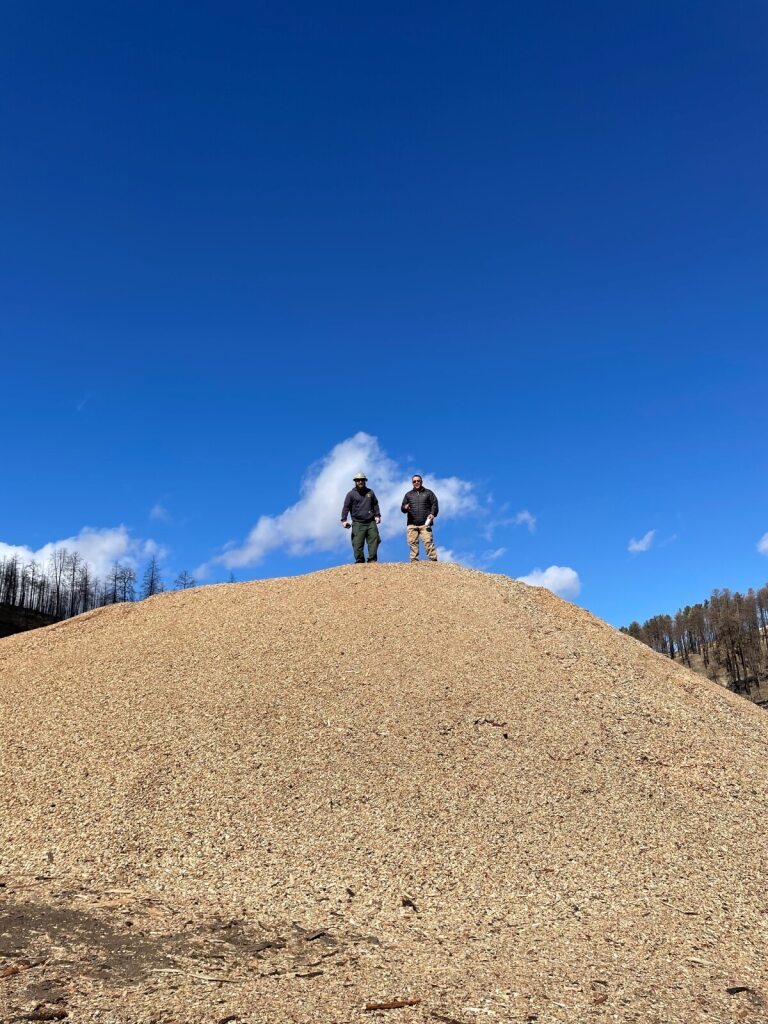
Project forester Mitchell Harper and a landowner admire the view from a pile of wood chips. These chips will be used to cover bare soil to prevent future erosion issues.
Application Status Lookup
Applicants can now look up your application status by submission ID. All applicants who successfully submitted an application will receive an email from automation@app.smartsheet.com with their application number. Statuses will be updated as projects are implemented. If you cannot locate your submission ID, please contact emnrd-southfork@emnrd.nm.gov.
For privacy reasons, we are not able to share the underlying report, as it includes sensitive information for all applicants. Creating a Smartsheet account will not grant access to further details beyond what is already visible.
Please note: Application IDs reflect the order in which applications were received, not the order in which properties will be addressed. Project sequencing will follow the prioritization criteria outlined in the “Priority Areas” section above.
You can also view the tracker in a full-page version here.
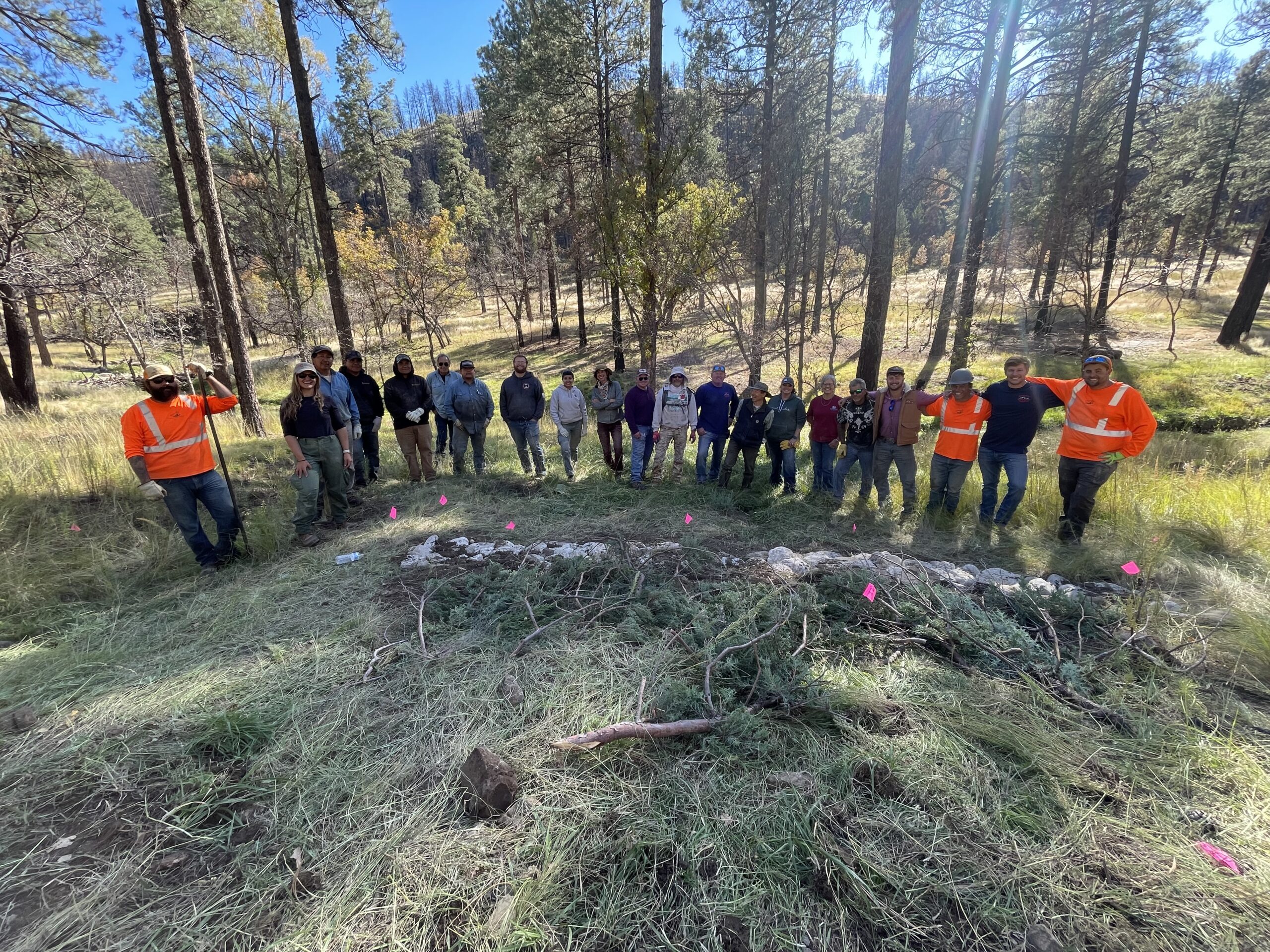
In October 2025, New Mexico Forestry Division staff and consultants from Ecotone Landscape Planning LLC held a 3-day erosion control structure workshop for local contractors. Attendees learned how to identify post-fire erosion issues and construct rock and brush structures to prevent future erosion issues. Above, workshop participants show off a media luna, which allows water to spread out as water runs downhill to prevent the formation of gullies.
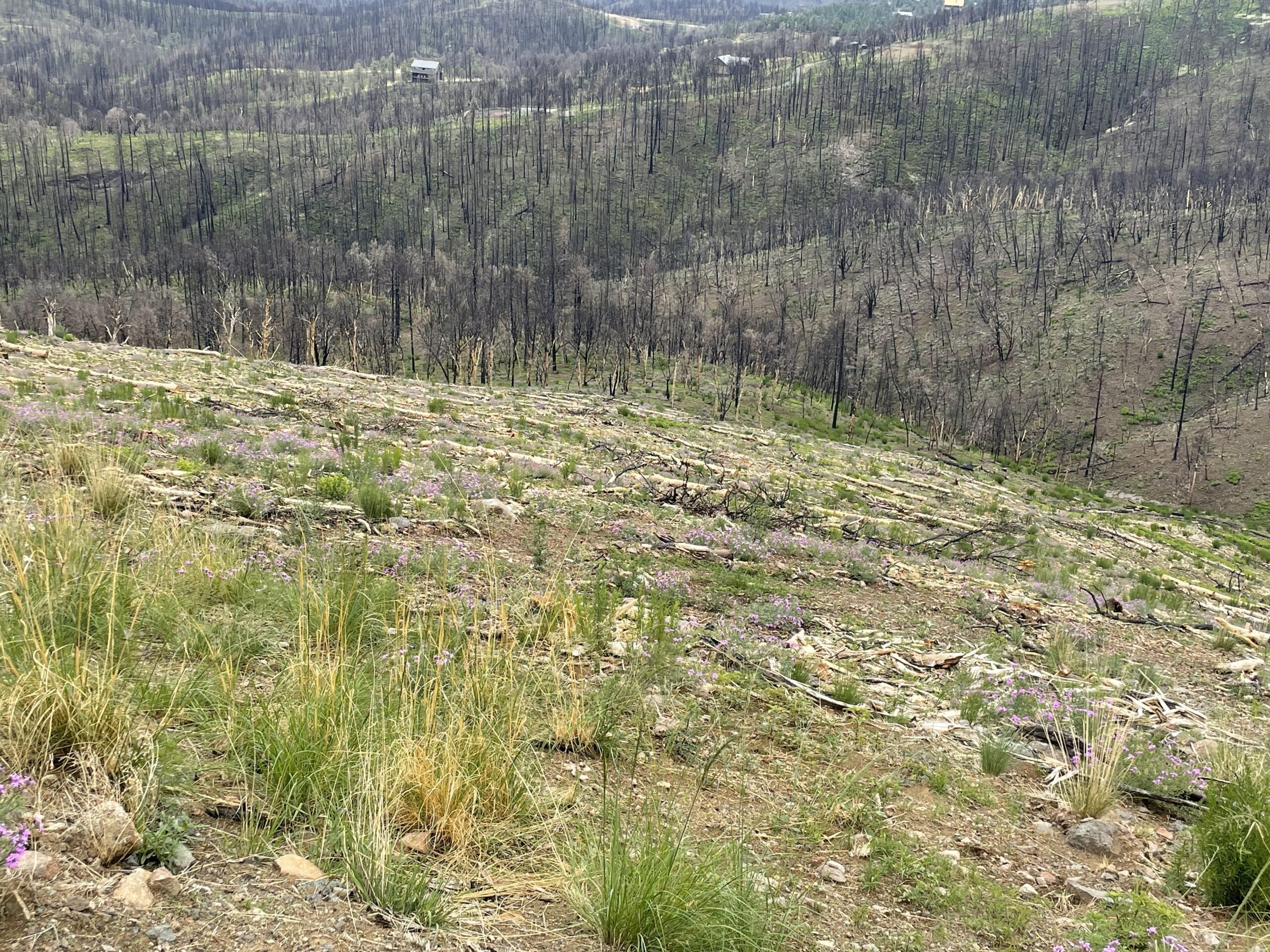
A contour felling project funded by the New Mexico Forestry Division. These log structures slowed the movement of sediment during recent rain events, allowing for the establishment of grasses and wildflowers.
Frequently Asked Questions
What does this program do and who does it benefit?
The program benefits everyone in and downstream of the burn scar by helping to stabilize the watershed. However, requests must come from landowners within the boundaries of the South Fork Fire burn scar (check with the map here: South Fork Fire perimeter map). The program provides funding for contractors to assess properties and conduct mitigation projects on private land. These projects will remove dead trees that pose a risk to structures, powerlines, and roads, as well as stabilizing slopes to reduce erosion and minimize downstream impacts from flooding.
Is there an application deadline?
Applying as soon as possible is recommended, as funding for the program is limited, and we cannot guarantee treatment for every enrolled property. However, there is no set deadline, and applications will be accepted on a rolling basis for properties within the burn scar. Contractors assess properties neighborhood by neighborhood, and if your application is not submitted before work in your area is completed, they may move on to the next location.
I signed up for the program. Why am I seeing delays with assessment and treatment on my property?
After the South Fork Fire, several assistance programs were made available to landowners. Most of those programs have now closed, and currently the New Mexico Forestry Division is the only agency still offering watershed stabilization services to new applicants.
The scale of the recovery effort is significant—over 4,000 acres of private land were affected by the fire, which is a large workload for a small team. In addition to limited staffing, there are processes outside of field staff control, such as contracting and procurement requirements, that can slow progress.
While future assistance programs may become available, funding uncertainties make this difficult to predict. Our team is working diligently to provide this critical service, but it’s important to understand that post-fire restoration is a long-term process that can take generations.
I do not want to wait for NMFD to treat my property. What should I do?
We understand waiting can be frustrating, and if you have the means to fund the work independently, that remains an option for faster implementation. In that case, NMFD can provide technical assistance and recommend contractors to complete the work. Please reach out to us at emnrd-southfork@emnrd.nm.gov for more information.
When can I start planting trees on my property?
Following wildfire, land can take time to heal to the point where it can support and grow seedlings. In the first 2-3 years following fire, we encourage landowners to focus on stabilizing soil through erosion control practices before replanting. We encourage all landowners to check out the NMFD Reforestation Program website to learn more about reforestation and stay up to date on developing programming.
We have partnered with American Forests, the nation’s oldest forestry non-profit, to help landowners develop climate-adapted reforestation plans and create planting prescriptions for contractors to implement. For more information and to schedule a site visit, contact Abigail Plecki (aplecki@americanforests.org).
We encourage landowners to consider the importance of maintaining defensible spaces around their homes as they engage in recovery and revegetation practices. Doing so could save your home from future wildfire damage. To learn more, visit our Fire Prevention website.
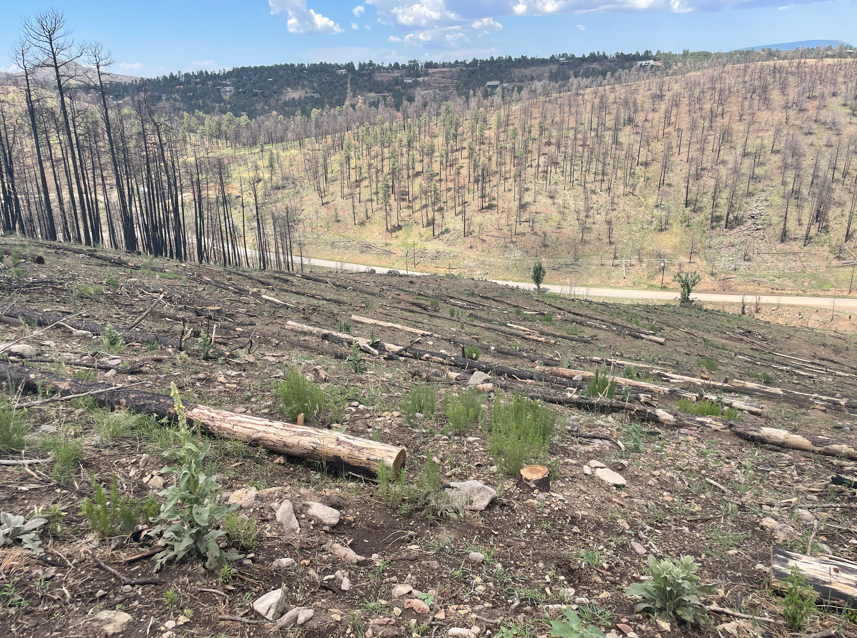
A contour felling project funded through the South Fork Watershed Stabilization Program in Ruidoso, NM. Contour logs help to trap sediment and seeds during precipitation events, stabilizing soil to allow for plant regrowth in burned areas. Image credit: Ethan Seavey.
Additional Post-Fire Resources and Supporting Organizations
Following wildfire, land can take time to heal to the point where it can support and grow seedlings. In the first 2-3 years following fire, we encourage landowners to focus on stabilizing soil through erosion control practices before replanting.
New Mexico Forestry Division
Capitan District Office
New Mexico Forestry Capitan District – The Capitan District spans the southeast corner of the state. It is comprised of Chaves, De Baca, Eddy, Lea, Lincoln, Otero, and Roosevelt Counties. The district provides technical assistance to landowners and has wildland fire suppression responsibilities that cover 30,877 square miles, encompassing nearly 8.6 million acres of private, non-federal, and non-municipal lands. The staff provides leadership and technical assistance on forest and watershed health projects, as well as fire safety issues.
New Mexico Reforestation Center
Reforestation Program – There is a shortage of suitable reforestation seedling providers in the southwest. To meet this need, NMFD is supporting The New Mexico Reforestation Center in scaling up seedling production in the coming years. NMFD is developing programs and resources to make these seedlings available to landowners and guide reforestation planning for the South Fork/Salt burned areas. Prior to planting seedlings, we recommend 1) connecting with the NMFD Capitan District Office to begin planning, 2) prioritize practices that stabilize the soil such as planting native grasses or shrubs, and 3) checking in with our Reforestation and Reforestation Resources page to learn more about reforestation and stay up to date on developing programming.
Conservation Seedling Program
Conservation Seedling Program – The Forestry Division offers low-cost seedlings to landowners to plant for reforestation, erosion control, windbreaks, streambank restoration, and wildlife habitat improvement. You can order seedlings from this program twice per year – generally beginning the first week of July and the first week of October. Because of the popularity of this program, we recommend planning ahead and being ready to submit your order as soon as the ordering period begins. Because the minimum order size is 49 seedlings per species, you may want to consider coordinating with neighbors or other community members to pool your orders. It is important to choose native shrub and tree species adapted to your location. For more information, please visit the Conservation Seedling Program page.
Other Federal, State, Municipal, and Non-Profit Resources
Please note that the following programs are not affiliated with the Forestry Division and must be applied for separately.
American Forests Post-Fire Reforestation Planning
American Forests is the nation’s oldest conservation non-profit. The organization supports landowners impacted by wildfire by conducting one-on-one site visits and providing guidance on best management practices for reforestation. Staff with American Forests can also help develop climate adapted reforestation plans and create planting prescriptions for contractors to implement. For more information and to schedule a site visit, contact landownersupport@americanforests.org.
New Mexico Department of Homeland Security and Emergency Management (DHSEM) Post-Fire and Flood Debris Removal Program
Private Property Debris Removal is a State of New Mexico coordinated program to remove debris from flood impacted properties. Services through DHSEM are free. To learn more, you can call Disaster Case Managers at 505-670-4662 or visit the Post-Fire and Flood Debris Removal Program website.
DHSEM Community Development Block Grant: New Mexico Home Recovery Program
New Mexico Department of Homeland Security and Emergency Management is now accepting “intent to apply” forms for the Community Development Block Grant for Disaster Recovery to support community recovery in areas that were impacted by the South Fork and Salt Fires and the resulting flooding.
$100 million of this block grant will go toward the New Mexico Home Recovery Program, which will provide repairs, reconstruction, or new construction of homes for disaster-impacted households in Lincoln and Chavez counties. Please note that second homes are ineligible for this grant.
To learn more, please visit: Community Development Block Grant: DR-4795 and DR-4843 – NMDHSEM.
NRCS Environmental Quality Incentives Program
The Environmental Quality Incentives Program (EQIP) through the U.S. Department of Agriculture Natural Resources Conservation Service is a conservation program that helps farmers, ranchers, and forest landowners integrate conservation into working lands. For more information and determine whether you qualify, please visit the New Mexico EQIP website.
South Central Mountain Resource Conservation and Development Council (SCM RC&D)
SCM RC&D is a non-profit that works collaboratively with area partners to bring resources and support to the residents of Lincoln and Otero Counties. SCM RC&D is serving as the lead local sponsor overseeing the NRCS Emergency Watershed Protection Program. To learn more about how the SCM RC&D Council can assist, contact Laura Doth at laura@scmrcd.org.
Upper Hondo Soil and Water Conservation District
Upper Hondo educates and informs the public on programs available to them for soil and water conservation practices as well as noxious weed eradication. They offer cost share plans for those who qualify in the areas of brush control, erosion control, pipelines, dirt tanks, cross fencing and rainwater harvesting. The District has specific grass seed mixes designed for post-fire stabilization, which they sell to community members with instructions for the best germination rates. For more information, call 575-354-2220 or visit their website.
Resource Library
Recovery and Ecological Restoration
Recovery for Communities
- After Wildfire: A Guide for New Mexico Communities – This guide was written to help New Mexico communities recover after wildfire. It includes information on mobilizing your community, a list of resources available to communities and individuals for assistance, and a technical guide with information about post-fire treatments to address the catastrophic effects of wildfire on the land and to prepare for potential flooding. An effort is currently underway to
- FEMA Flood After Fire Toolkit – Social posts, infographics, videos, and more resources explaining why wildfires pose increased flooding risk for up to 5 years post-fire.
Best Management Practices for Ecological Restoration
- Contour Felling Landowner Guide – After severe fires, few trees or plants are left to hold soil in place, leading to erosion. Felling and anchoring burned trees along slope contours is one way to reduce erosion and stabilize slopes using materials on-hand. This guide provides an overview of contour felling principles and tips.
- After the Fire: Bark Beetle Management – Bark beetles are a native decay agent found in many southwestern forests. Bark beetles typically attack weakened trees when their defenses are poor. Although destructive, the appetite of bark beetles naturally increases the diversity of tree age and tree size across the forest. After a major wildfire disturbance or drought, however, populations can swell and attack healthy trees. This document lays out bark beetle biology and life cycle, identification and assessment of colonized trees, and management strategies.
Additional resource guides can be accessed by following the links below:
Mental Health and Legal Support Services
Legal Aid Disaster Resource Center: New Mexico South Fork Fire and Salt Fire – Provides a repository of safety and shelter resources, legal assistance, and news and information regarding the South Fork and Salt Fires and other natural disasters.
New Mexico Crisis and Access Line – Whether you’re feeling overwhelmed, struggling with stress, or just need someone to talk to, trained professionals with the New Mexico Crisis and Access Line are ready to listen – 24/7, free, and completely confidential.
-
-
- Call 1-855-NMCRISIS (662-7474) and/or dial 988
-
Disaster Distress Helpline – The first national hotline dedicated to providing year-round disaster crisis counseling. This toll-free, multilingual, crisis support service is available 24/7 to all residents in the U.S. and its territories who are experiencing emotional distress related to natural or human causes.
-
-
- Call or text 1-800-985-5990.
- Si habla Español: Llama o envía un mensaje de texto 1-800-985-5990 presiona “2.”
- For Deaf and Hard of Hearing ASL Callers: Please text or call the Disaster Distress Helpline at 1-800-985-5990 using your preferred Relay provider.
-
Wildfire Preparedness and Education
- Living with Fire Guide New Mexico – Provides recommendations and resources to homeowners, educators, community groups, and firefighting professionals to prepare for wildfire and reduce wildfire threats to homes and communities.
- Firewise USA – Provides simple, effective steps to help communities reduce the risk of destruction from wildfire.
- Fire Adapted Communities Learning Network (FAC Net) – People learning and working together are the foundation of fire adaptation. FAC Net invests in people and in place-based efforts to change relationships with fire.
Contact us
If you have any questions regarding the program or your application status, please contact us at emnrd-southfork@emnrd.nm.gov.